

A Code of Ethics Built Together: How TEC-SIM Wrote Its Own
TEC-SIM has recently developed and adopted a Code of Ethics. The document matters, but so does the way it was written. It is the result of a shared process of training and teamwork, and the people who will live by it contributed to it.

What a code of ethics is
A code of ethics is a written statement of the principles an organization commits to follow and the behaviors it expects from everyone who works in it or on its behalf. It does not replace laws, contracts or technical standards. It covers what they cannot: how people should act when a rule is silent, when two interests conflict, or when the easy choice is not the right one.
Its fields of application are broad. A code typically addresses relations among colleagues and between staff and management, relations with customers and suppliers, the handling of confidential information, the integrity of quality and test records, health and safety, environmental responsibility and the avoidance of conflicts of interest. In short, it covers every point where a personal decision can affect the company, its partners or the people around it.
For a manufacturer of vaccum and pressure vessels mainly for the pharmaceutical industry, these questions are very practical. The sector depends on traceability, documentation and trust. A certificate must reflect the real material, an inspection record must reflect the real situation, and a delivery date must reflect what can actually be achieved. A shared ethical framework supports the technical discipline that this kind of equipment requires.
What the code covers at TEC-SIM
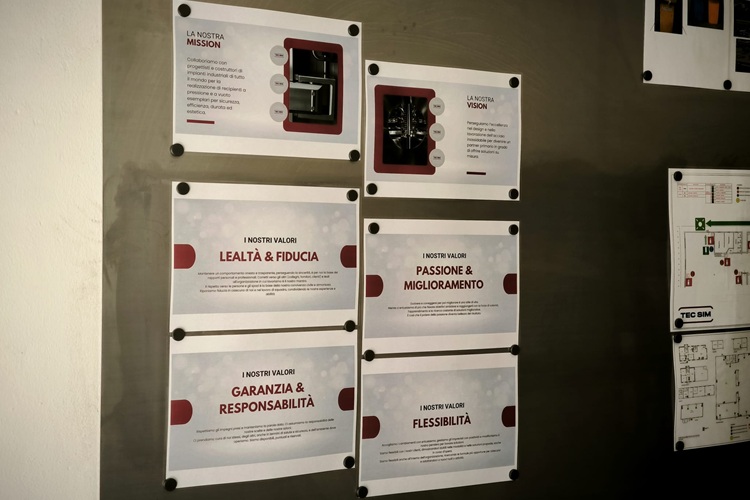
The TEC-SIM code of ethics contains the company’s vision, mission and values, which together define who the company is, what it does and how it intends to do it.
The vision states the ambition: We pursue excellence in stainless-steel design and manufacturing to become a leading partner capable of offering tailored solutions. The mission describes the daily work: We work worldwide with designers and producers of industrial plants to manufacture vacuum and pressure vessels that are exemplary in terms of safety, efficiency, durability, and aesthetics.
The values are four: Loyalty & Trust, Passion & Improvement, Warranty & Liability and Flexibility. They guide how colleagues treat one another, how the company deals with customers, suppliers and partners, and how responsibility for quality, safety and accuracy is shared across every department, from the design office to the workshop floor.
The code is not meant to stay a text on paper. It is a reference that anyone in the company can use to read a difficult situation, to decide how to act, and to explain that decision to others. Because the staff helped shape its content, its language reflects the real work of the company and not an abstract template.
The method: involving people at every level
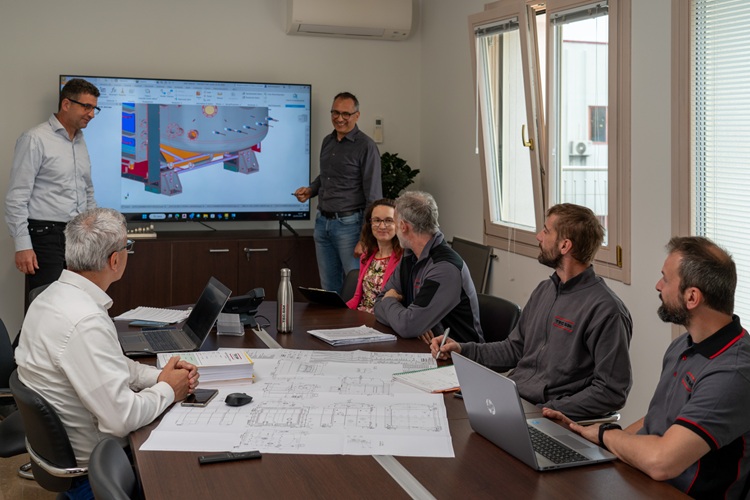
The method was designed to be inclusive and orderly. It began with training. Top-level staff took part directly in classroom sessions, where the concept of a code of ethics was explored and the main themes were discussed in depth. The rest of the staff was consulted through an online questionnaire. Its purpose was to gather ideas, needs and opinions on what the code should contain, and it gave every employee a say without the constraints of a meeting room.
The values were chosen together. The people of TEC-SIM selected the ones that best reflect the nature of the company and its working environment, so the values describe how the company already operates and were not imposed from outside.
The contributions were then put into writing and shared with top-level management. Once the draft was aligned, it was presented to the entire company. The code was then posted on the company notice board for ten days, so that anyone could submit comments or objections before it took effect. When that period ended, the code officially entered into force.
The whole process was overseen by an external professional, who ensured that it remained impartial and comprehensive. An outside facilitator has no stake in the internal balance of the company, can notice what is missing, and helps make sure that every voice is heard and that none dominates.
Why the code and the method matter
The two go together. A code imposed from above is easy to produce, but it is often received as a formality, and people follow it reluctantly or not at all. A code that has been discussed, written with input from the people it concerns, and tested through an open comment period carries a different weight. Employees recognize their own contribution in it, and they are more likely to apply it in practice and to hold themselves and others to it.
The structure of the process also matters. Combining classroom work with a questionnaire allowed both in-depth discussion and broad participation. The review by management gave the document consistency, and the notice period gave it legitimacy. The external supervision provides a further guarantee that the result is balanced.
Expectations for the existing staff
For the people already working at TEC-SIM, the adoption of the code has had a visible effect: it has created big expectations in some of them. This is a positive sign, because it shows that the process was taken seriously and that people see the code as something that can improve the way the company works. It also carries a responsibility. A code raises the standard of what colleagues expect from one another and from management, and it will be judged by consistency between the words and the daily behavior. Keeping those expectations alive requires that the principles are applied in concrete decisions, and that the code is revisited as the company evolves.
Expectations for new staff
For people joining the company, the code will be an essential part of onboarding. It tells them, from the first days, what TEC-SIM values and how it expects its people to act. It gives them a common language to understand the culture of the company, and a point of reference when they face situations that no procedure covers. New colleagues will also receive a clear message: this is a company whose principles are written down, were developed by the people who work there, and are expected to be applied in practice.
A starting point
Adopting the code is not the end of the work. It marks the start of a phase in which the principles must be applied, discussed and kept up to date. For TEC-SIM, building the code together was a way to reinforce what the company already tries to do every day: to work with rigor, transparency and respect, in a sector where trust is the foundation of every relationship.